[ISOCC 2025] LLM on FPGA: Squeezing Language Models by Quantization and Multi-Query Attention and Its Efficient Hardware Architecture
Published:
Delighted to share that my research has been accepted to an oral session of ISOCC 2025 – 22th International SoC Design Conference! (presented on October 16, 2025)
you can find the whole paper : LLM on FPGA: Squeezing Language Models by Quantization and Multi-Query Attention and its Efficient Hardware Architecture link
The paper got recognized “For enabling analytical evaluation of various quantization schemes (SmoothQuant and QLoRA) and implementing on-chip caches of large language models without siginificant accuracy drop by using Multi-Query Attention and efficient RTL design.”
LLM on FPGA: Squeezing Language Models by Quantization and Multi-Query Attention and Its Efficient Hardware Architecture
Authors:
Seoyoon Chae (Dept. of Electronic and Electrical Engineering, Sungkyunkwan University)
Taewook Kang (Dept. of Semiconductor Convergence Engineering, Sungkyunkwan University)
🔗 Code: https://github.com/chae-sy/squeezing_lm
Abstract
We present an on-chip implementation of a compressed Transformer-based language model on a Xilinx Artix-7 FPGA.
Our main contributions are:
- Hybrid compression: Combining 4-bit quantization and multi-query attention (MQA) compresses the KV cache by 8×, supporting sequences up to 256 tokens.
- Streaming hardware design: A Verilog implementation of pre-layernorm, attention, and feed-forward sublayers optimized with BRAM and DSP utilization.
- Post-synthesis performance: Achieving 4.4 K tokens/s at 250 MHz with 31.9% BRAM and 85% DSP utilization.
This prototype enables fully on-chip generative inference, advancing privacy-preserving and edge-deployable large language models.
Keywords: Large Language Model (LLM), Quantization, Multi-Query Attention, Transformer Accelerator, FPGA, On-Device Inference, Hardware–Software Co-Design
1. Introduction
Transformer-based large language models (LLMs) achieve state-of-the-art performance but require substantial compute and memory resources Autoregressive generation typically caches key–value (KV) tensors, reducing attention complexity from O(S²d) to O(Sd) per token. However, storing 8-bit KV tensors on-chip severely limits sequence length.
For example, with 608 KiB BRAM on an Artix-7 FPGA, the on-chip KV capacity is:
\[\text{Token capacity}=\frac{608\,\text{KiB}}{12\,\text{layers} \times 2\,\text{KV tensors} \times 768\,\text{B}}\approx 33\,\text{tokens.}\]To overcome this limitation, we integrate sub-8-bit quantization and MQA to compress the KV cache over 8×, enabling 256-token inference without DRAM.
Key contributions:
- 4-bit KV quantization using SmoothQuant + LoRA-QAT achieves near-lossless accuracy (< 0.02 drop).
- MQA (shared K/V across heads) cuts bandwidth while preserving quality.
- FPGA co-design: A streaming Transformer block implemented entirely in Verilog.
2. Related Work
Previous research explored:
- Multi-head attention acceleration on systolic arrays [2].
- ASICs using per-vector 4-bit scaling [3].
- FPGA frameworks applying pruning [4].
However, none jointly exploit sub-8-bit quantization and KV caching for generative LLM inference under FPGA-scale memory constraints.
3. Model Compression Methodology
3.1 SmoothQuant for Range Equalization
SmoothQuant [5] was used to mitigate activation outliers before quantization.
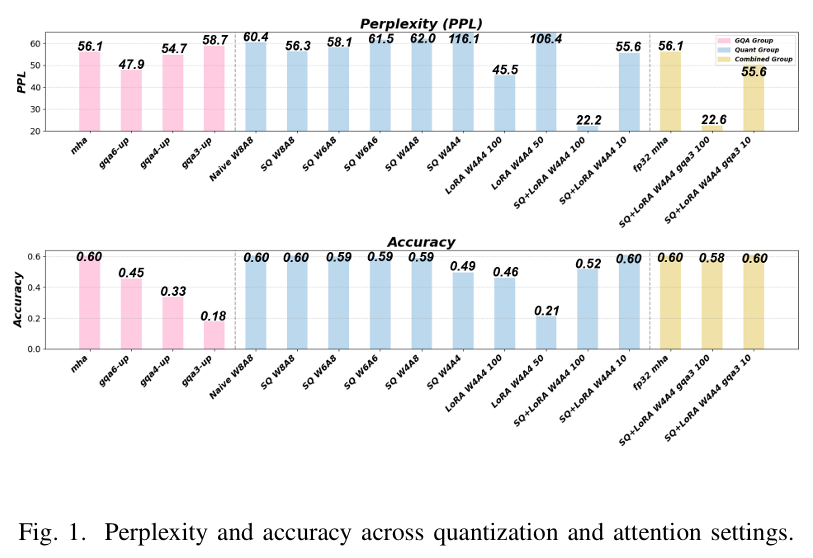
- Stable results for W8A8–W6A6 (PPL ≈ 60, Accuracy ≈ 0.6).
- Instability observed at W4A4 (PPL = 116.1, Accuracy = 0.49).
3.2 LoRA-Based Quantization-Aware Training
LoRA adapters (rank = 8) were inserted into Q/K/V projections and fine-tuned on WikiText-2 for 10–100 steps (frozen backbone).
- PPL = 45.5 after 100 steps.
- Combining with SmoothQuant reduced PPL to 22.2 (100 steps) and 55.6 (10 steps).
3.3 Multi-Query Attention (MQA)
Standard MHA computes separate K/V per head → high memory cost.
MQA shares K/V across all heads; GQA shares within groups.
In our experiments:
- Group-3 MQA saved significant memory.
- Slight trade-off: +2.6 PPL vs. baseline MHA.
Result Summary:
| Configuration | Training Steps | PPL | Accuracy |
|---|---|---|---|
| W4A4 + SmoothQuant (10 steps) + G3 MQA | 10 | 55.6 | 0.60 |
| W4A4 + SmoothQuant (100 steps) + G3 MQA | 100 | 22.6 | 0.58 |
4. Hardware Architecture
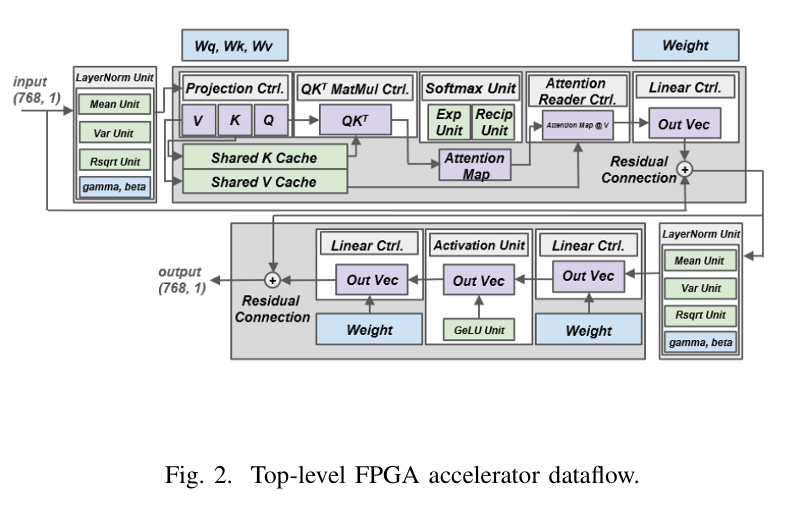
The hardware pipeline consists of pre-layernorm, attention, and feed-forward network (FFN) units
4.1 Pre-LayerNorm
Computes per-channel mean/variance, approximates \(\frac{1}{\sqrt{\sigma^2 + \epsilon}}\) using a LUT-based reciprocal square root, and applies 4-bit affine parameters (γ, β).
4.2 Attention and FFN Engines
- Attention Unit:
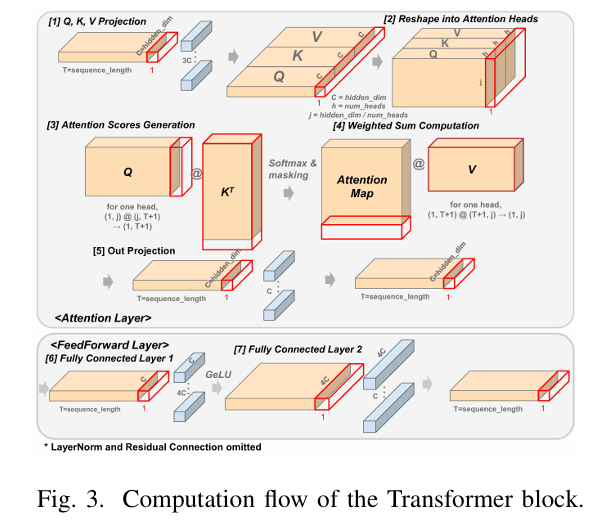
- Generates concatenated Q/K/V via 1×1 convolution.
- Stores 4-bit compressed K/V in shared BRAM.
- Computes Q–K dot-products on a PE array.
- Applies masked softmax using exp/reciprocal LUTs.
- Produces context vector via weighted sum over V.
- Feed-Forward Network (FFN):
- Expands C → 4C → C.
- Uses LUT-based GELU activation.
- Implemented as streaming matrix-vector (mat-vec) computations using DSPs and BRAM.
4.3 Resource Utilization
| Resource | Used | Available | Utilization (%) |
|---|---|---|---|
| DSP slices | 204 | 240 | 85.0 |
| BRAM | 193.5 KB | 608 KB | 31.9 |
| LUTs | 10,000 | 63,400 | 15.7 |
5. Evaluation
- Platform: Xilinx Artix-7 100T (CSG324)
- Tool: Vivado 2018.3
- Clock Frequency: 250 MHz
The fully pipelined design sustains 1 token per cycle (after pipeline fill), reaching 4.4 K tokens/s throughput.
On-chip memory supports sequence length ≤ 256 tokens, entirely without external DRAM.
6. Conclusion and Future Work
This work demonstrates the first fully on-chip FPGA-based LLM inference using:
- 4-bit quantization,
- Multi-Query Attention, and
- A streaming Verilog architecture.
The prototype achieves real-time generation within 31.9% BRAM and 85% DSP budgets.
Future directions include:
- Scaling to larger LLMs,
- Mixed-precision inference, and
- Energy-efficiency optimization.
References
- Vaswani et al., “Attention Is All You Need,” NeurIPS 2017.
- Lu et al., “Hardware Accelerator for Multi-Head Attention and FFN,” IEEE SOCC 2020.
- Keller et al., “A 95.6-TOPS/W Inference Accelerator with 4-bit Quantization in 5 nm,” IEEE JSSC 2023.
- Zhang et al., “Algorithm-Hardware Co-Design of Attention on FPGA Devices,” ACM TECS 2021.
- Xiao et al., “SmoothQuant: Accurate and Efficient Post-Training Quantization for LLMs,” ICML 2023.
- Hu et al., “LoRA: Low-Rank Adaptation of LLMs,” ICLR 2022.
- Shazeer, “Fast Transformer Decoding: One Write-Head Is All You Need,” arXiv 2019.
- Ainslie et al., “GQA: Generalized Multi-Query Transformers,” arXiv 2023.