[tape-out project] CNN-based keyword spotting system with framewise incremental computation
Published:
This project describes the design and implementation of a CNN-based keyword spotting system, including algorithm selection, RTL design, logic synthesis, and place-and-route for tape-out submission.
Research Period: September 2, 2024 – December 20, 2024
Researcher: Seoyoon Chae
Affiliation: Sungkyunkwan University
1. Paper Review and Algorithm Design
(1) Paper Review
To investigate keyword-spotting (KWS) techniques, several papers were reviewed. Among them, one notable study proposed generating two-dimensional representations of speech signals by dividing them into frequency and time axes, then processing them through a CNN-based network [1].
The paper also described an integer-quantized approach to reduce power consumption and a custom processing-element (PE) architecture with a dedicated memory structure, optimized for low-power hardware. The study further minimized on-chip memory area by reducing SRAM size, which inspired the memory design adopted in this work.
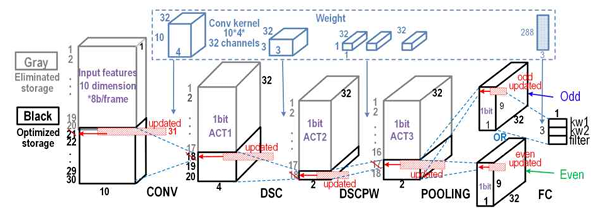
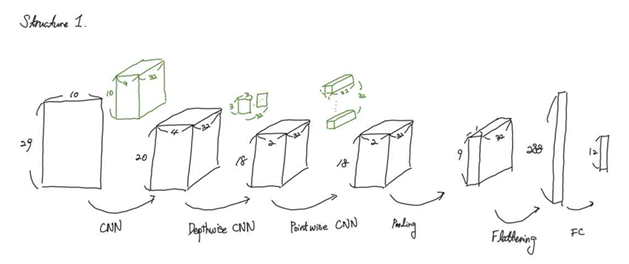
However, the reference architecture could detect only one or two keywords, which is insufficient for large-scale KWS deployment. Therefore, in this research, the quantized bit-width was expanded from 1-bit to 8-bit, enabling the detection of five distinct keywords. The speech signal was sampled every 32 ms, and the feature-extraction circuit transformed the incoming waveform into 10 frequency bands using FFT before applying CNN operations.
The Depthwise Separable Convolutional Neural Network (DSCNN) architecture was adopted to reduce computational cost while maintaining accuracy. Although it increases the number of stages by decomposing conventional convolution into depthwise and pointwise operations, it significantly lowers overall computation and memory usage to approximately one-seventh of a standard CNN. Python-based training confirmed about 90% recognition accuracy under this structure.
(2) BC-ResNet Model Design
To extend the number of recognizable keywords to ten, several lightweight AI architectures for KWS were examined. Among them, BC-ResNet [2] demonstrated high classification accuracy with low parameter count and FLOPs, making it suitable for hardware implementation.
| Model | Parameters | FLOPs | Accuracy (%) | Keywords |
|---|---|---|---|---|
| BC-ResNet-1 | 9.2 K | 3.1 M | 96.9 | 10 |
| DS-CNN S | 24 K | 5.4 M | 94.4 | 10 |
| TC-ResNet8 | 66 K | 3.0 M | 96.1 | 10 |
| Res8-Narrow | 20 K | 143.2 M | 90.1 | 10 |
Using PyTorch, the smallest BC-ResNet-1 model was fine-tuned and trained on the Google Speech Commands v2 dataset, achieving 92.8% accuracy on the evaluation set.
The architecture included convolutional, batch-normalization, ReLU6, dropout, and adaptive average-pooling layers, structured as modular blocks optimized for parameter efficiency.
2. RTL Design
(1) DSCNN RTL Implementation
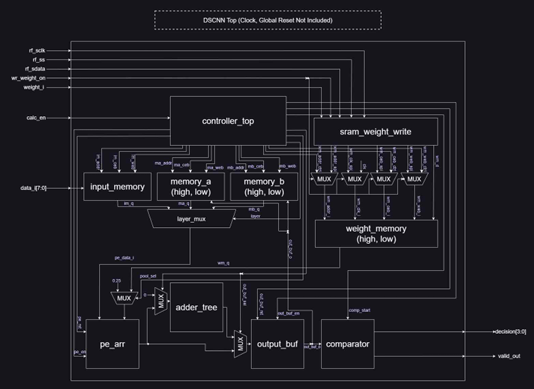
For hardware realization of keyword spotting, the system was designed at Register-Transfer Level (RTL) using Verilog/SystemVerilog. The architecture comprised:
- Weight Memory – stores pre-trained CNN weights
- Input Memory – receives features from the front-end
- Internal Memory – buffers intermediate results
- Controller – orchestrates operation sequencing
- PE Array – performs MAC operations (32 PEs, each 8-bit)
- Adder Tree, Output Buffer, and Comparator modules
Weights were trained offline and loaded via SPI communication. Each PE executed 8-bit integer MAC operations, and verification through testbench simulations confirmed correctness.
The Adder Tree module aggregated partial sums from PEs during pointwise or fully connected layers, implemented as a single-cycle combinational logic block to minimize latency.
The Output Buffer temporarily stored completed channel outputs and applied the ReLU activation function with saturation.
The Comparator performed a tournament-style search to identify the maximum activation value, corresponding to the detected keyword.
The Controller Module coordinated all submodules across five layers, managing memory addresses, enable/reset signals, and inter-layer synchronization.
Latency analysis showed approximately 560 clock cycles total (182 + 24 + 258 + 7 + 85 + inter-layer transitions).
(2) BC-ResNet RTL Implementation
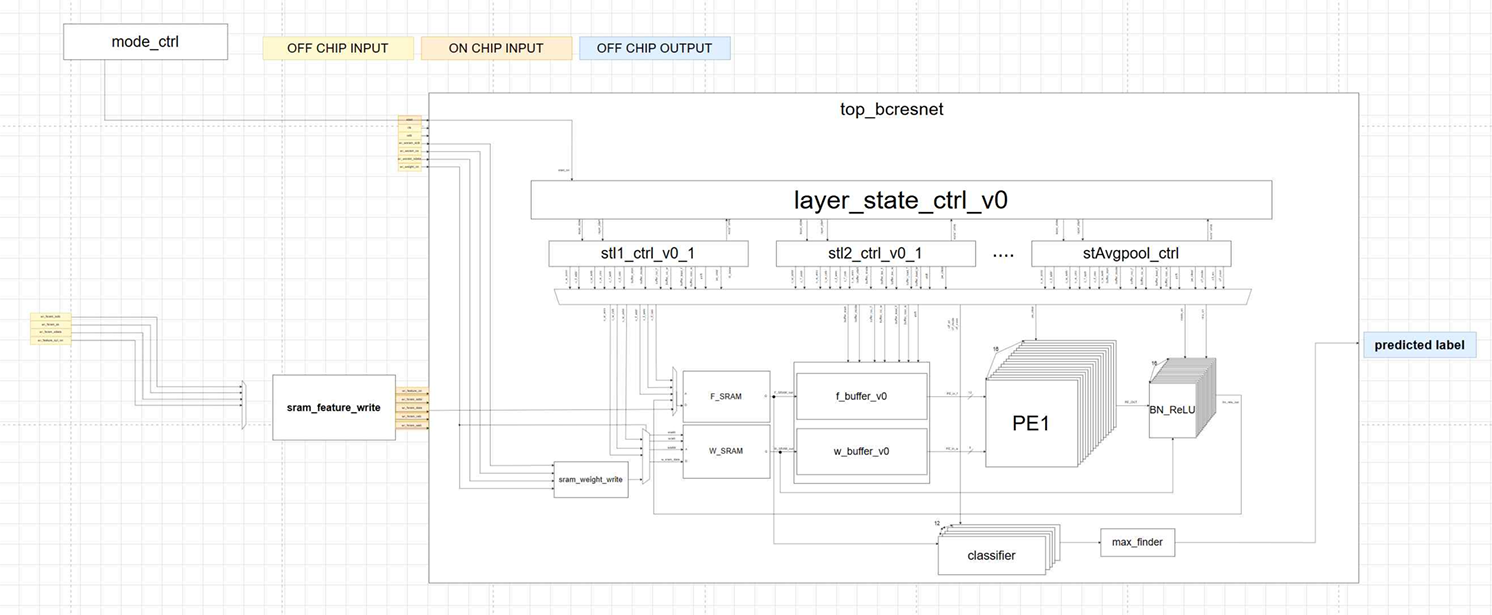
A more advanced circuit was designed to execute BC-ResNet inference in real time. The top-level architecture included:
- PE Array (16 PEs) for convolutional MAC operations
- Normalization Module for batch normalization
- ReLU + Quantization Module for activation and 8-bit precision adjustment
- Classifier Module performing average pooling and output aggregation
- Max-Finder Module selecting the highest-scoring output label
Feature and weight data were stored in FSRAM and WSRAM, respectively, with intermediate feature/weight buffers feeding the PE array.
Control was handled by a top controller, a layer-state controller, and 23 layer controllers that managed each computational stage.
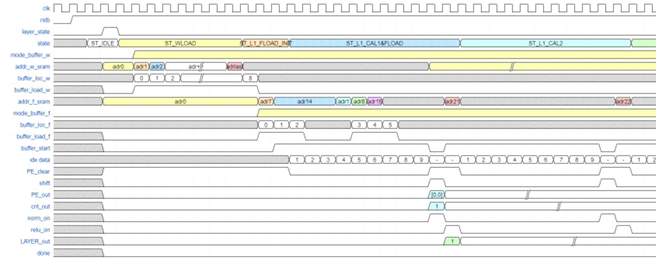
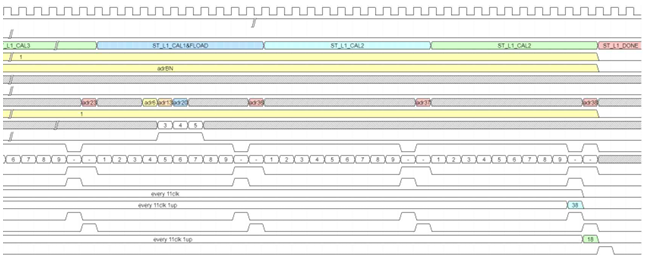
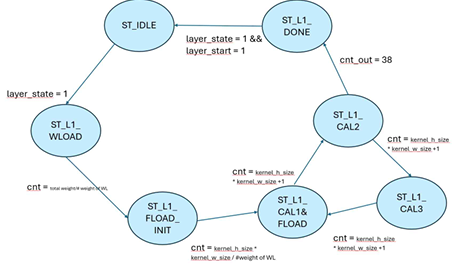
A detailed state-machine design ensured correct sequencing of weight loading, feature buffering, convolution, normalization, and activation per layer.
A frame-wise computation scheme was adopted to eliminate redundant operations between overlapping spectrogram windows (20 × 30 frequency × time). This incremental computation method [1] achieved equivalent results to full-window convolution with reduced redundancy, verified through timing analysis.
3. Logic Synthesis
After RTL verification, the design was synthesized using Synopsys Design Compiler for fabrication under Samsung 28 nm CMOS through the IDEC MPW Program.
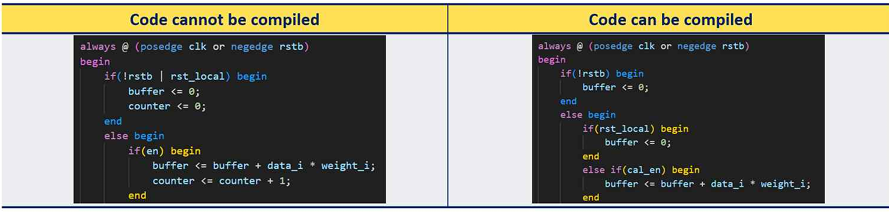
During synthesis, non-synthesizable coding patterns (e.g., mixing blocking and non-blocking assignments, reserved identifiers, multi-signal resets) were corrected to ensure structural logic generation.
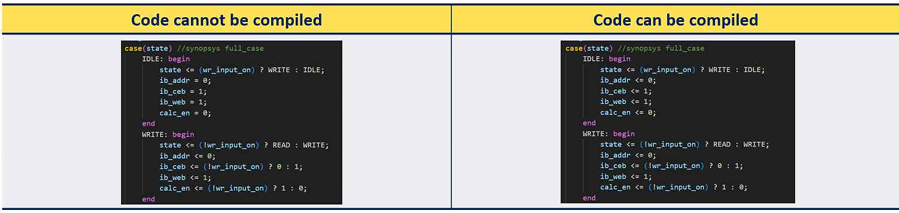
A memory wrapper cell was designed for each SRAM instance to:
- prevent direct internal routing to memory cells, and
- tie off unused I/O pins for electrical stability.
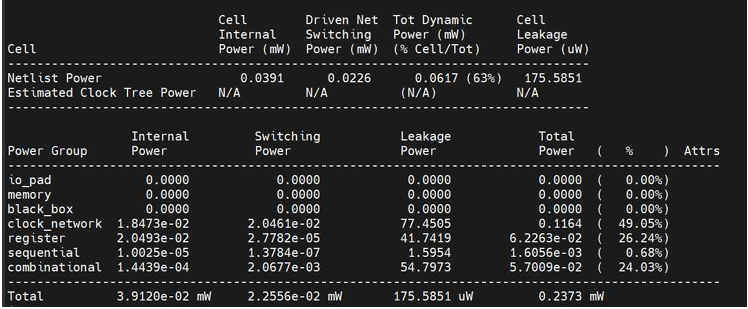
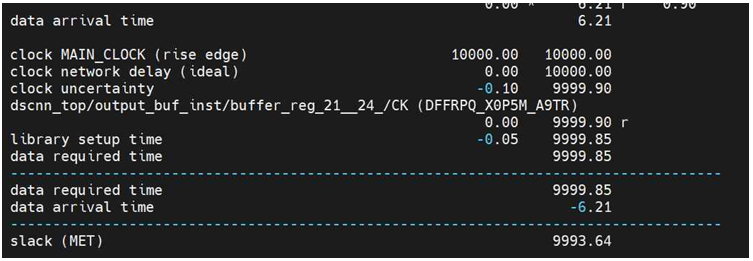
Post-synthesis, the top-level hierarchy was analyzed for power and timing, confirming functionality within expected constraints.
4. Place and Route (P&R)
The physical implementation was carried out using Synopsys IC Compiler II.
The flow consisted of placement, clock-tree synthesis (CTS), and routing stages.
Memory Wrapper P&R
- Imported physical libraries for memory cells provided by the foundry.
- Defined cell dimensions and placement coordinates.
- Added blockage boundaries to prevent routing through memory regions.
- Implemented power-plan connections (VDD/VSS) and guard-ring structures for stable power delivery.
Top Module P&R
- Instantiated completed memory wrappers.
- Created a mesh-style power grid across the layout.
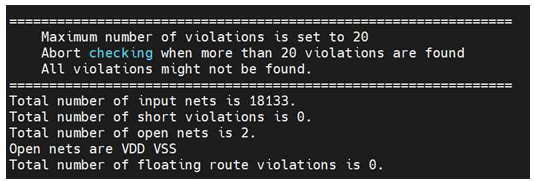
- Performed Design Rule Check (DRC) and Layout vs Schematic (LVS) verification.
- Added I/O pad configurations and finalized GDSII files for tape-out submission.
All DRC/LVS checks were passed, and the design was submitted to the foundry for final fabrication.
References
[1] W. Shan et al., “A 510-nW Wake-Up Keyword-Spotting Chip Using Serial-FFT-Based MFCC and Binarized Depthwise Separable CNN in 28-nm CMOS,” IEEE J. Solid-State Circuits, 56(1):151–164, Jan. 2021.
[2] B. Kim et al., “Broadcasted Residual Learning for Efficient Keyword Spotting,” arXiv:2106.04140, 2023.
[3] Y. Zhang et al., “Hello Edge: Keyword Spotting on Microcontrollers,” arXiv:1711.07128, 2018.
[4] S. Choi et al., “Temporal Convolution for Real-Time Keyword Spotting on Mobile Devices,” arXiv:1904.03814, 2019.
[5] R. Tang and J. Lin, “Deep Residual Learning for Small-Footprint Keyword Spotting,” Proc. ICASSP 2018, pp. 5484–5488.
Acknowledgment
This research was conducted as part of the Undergraduate Research Program (URP) and supported by the IDEC Multi-Project Wafer (MPW) initiative using Samsung 28 nm CMOS process.